Discover the Transformative Camino Pilgrimage Routes: Uncover Your Path to Santiago
The Camino de Santiago, or “Way of St. James,” is an ancient network of Camino pilgrimage routes stretching across Europe, all leading to the Cathedral of Santiago de Compostela in Galicia, Spain. The pilgrimage is one of the oldest and most significant in the world, with origins dating back to the 9th century. Though historically a religious journey, today the Camino pilgrimage routes attract people from all walks of life for a variety of reasons, from spiritual reflection and personal growth to physical challenge and adventure.
A Labyrinth of Routes: Choosing Your Way
The Camino de Santiago is far more than just one path. It consists of a complex network of Camino pilgrimage routes, each offering a distinct experience for pilgrims. Whether you’re seeking a well-traveled path, a secluded journey, or a route that best fits your fitness level, there’s a Camino pilgrimage route to suit your needs. Some pilgrims choose to walk the entire journey from their home, while others may opt for specific segments, tailoring the pilgrimage to their available time and physical capabilities.
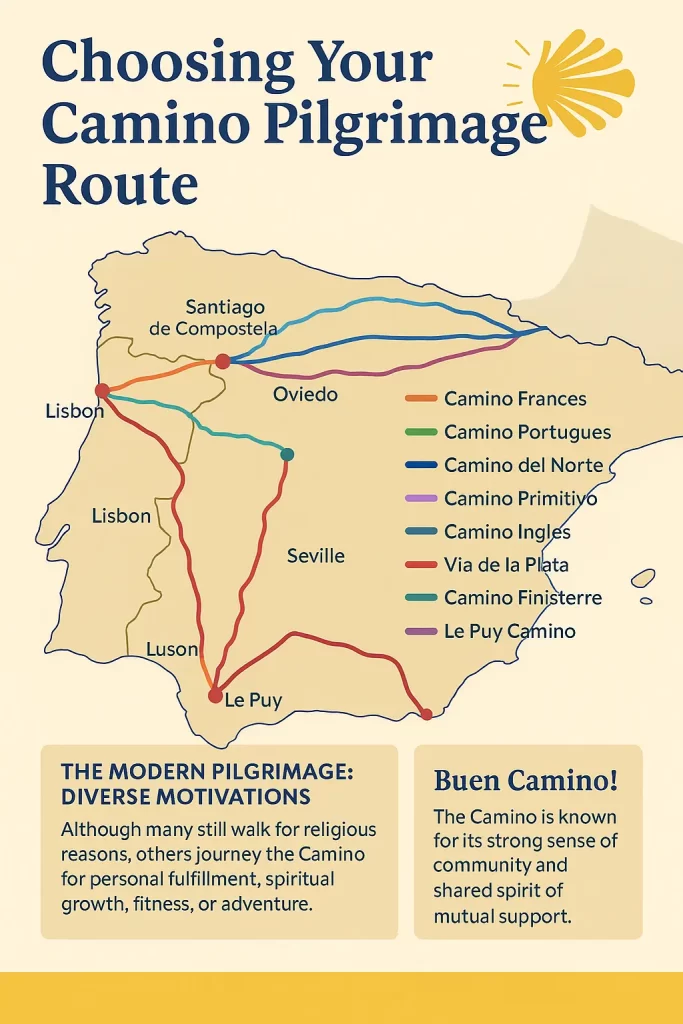
Below are some of the most popular Camino pilgrimage routes:
Camino Frances (The French Way)
The Camino Frances is the most traveled and well-known Camino pilgrimage route, starting in Saint-Jean-Pied-de-Port in France and stretching approximately 800 kilometers (485 miles) to Santiago de Compostela. It takes most pilgrims 30 to 40 days to complete, passing through diverse terrains—from the rugged Pyrenees mountains to the rolling plains of northern Spain. Along the way, pilgrims visit vibrant cities such as Pamplona, Leon, and Burgos. The last 100 kilometers from Sarria are particularly popular, as this section qualifies pilgrims for the Compostela certificate.
Camino Portugues (The Portuguese Way)
The Camino Portugues starts in Lisbon or Porto in Portugal, covering around 600 kilometers (373 miles) to Santiago. It is known for its stunning coastal landscapes, especially the variant that hugs the Atlantic Ocean, offering breathtaking sea views. Many pilgrims opt for this route to experience a more peaceful atmosphere compared to the busier Camino pilgrimage routes like the Camino Frances.
Camino del Norte (The Northern Way)
Following the rugged northern coast of Spain, the Camino del Norte is also known as the Ruta de la Costa. This Camino pilgrimage route spans approximately 825 kilometers (512 miles) from Irún to Santiago, passing through the Basque Country, Cantabria, and Asturias. It offers spectacular coastal views but can be more challenging due to its hilly terrain. For food lovers, this route is a treat, passing through culinary hubs like San Sebastián and Bilbao, offering the opportunity to savor local Basque cuisine.
Camino Primitivo (The Original Way)
The Camino Primitivo is considered the first Camino pilgrimage route to Santiago, dating back to the 9th century. It begins in Oviedo in Asturias and travels through mountainous terrain to join the Camino Frances in Melide. This challenging route is favored by experienced hikers due to its steep ascents and remote landscapes. Pilgrims walking the Camino Primitivo will find themselves in quiet, natural surroundings, perfect for those seeking a spiritual and physically demanding journey.
Camino Ingles (The English Way)
The Camino Ingles is one of the shortest Camino pilgrimage routes, typically covering 121 kilometers (75 miles). It starts in the Galician towns of Ferrol or A Coruña and has historical significance, as it was traditionally used by pilgrims from England, Ireland, and Scandinavia. The route can be completed in about 4-6 days and is ideal for those who want to experience the Camino in a shorter time frame.
Via de la Plata (The Silver Way)
The Via de la Plata is the longest of the Camino pilgrimage routes, stretching approximately 1,000 kilometers (620 miles) from Seville in southern Spain to Santiago de Compostela. While it is less crowded than the Camino Frances, it can be challenging due to its distance and the extreme summer heat. The route takes pilgrims through diverse landscapes, from the plains of Castile to the forests of Galicia, and offers a unique opportunity to explore Spain’s rural heartlands.
Camino Finisterre (The Finisterre Way)
The Camino Finisterre is unique because it starts in Santiago de Compostela and heads westward to the coast, reaching Cape Finisterre, once thought to be the “end of the world.” Many pilgrims continue to this final destination to reflect on their journey, finding it a perfect way to complete their spiritual and physical pilgrimage.
Le Puy Camino (Via Podiensis)
The Via Podiensis, also known as the Le Puy Camino, starts in Le Puy-en-Velay, France, and spans over 750 kilometers (466 miles). This Camino pilgrimage route passes through some of France’s most stunning landscapes, including volcanic regions and medieval villages, with several UNESCO World Heritage Sites along the way. It is one of the oldest and most scenic Camino pilgrimage routes, offering a unique experience for those traveling outside of Spain.
Camino de Invierno (The Winter Way)
The Camino de Invierno is an alternative Camino pilgrimage route to the Camino Frances, designed to avoid harsh winter weather by passing through valleys and forests. Though less traveled, this route offers a more intimate experience, connecting pilgrims with nature and rural life in Galicia. It’s an ideal option for those looking to avoid crowded routes while embracing a connection with the natural world.
The Modern Pilgrimage: Diverse Motivations
The Camino de Santiago continues to draw pilgrims from all over the world, but today, motivations for undertaking the journey are diverse. While many still walk for religious reasons, others embark on the Camino for personal fulfillment, spiritual growth, fitness, or even adventure.
Some pilgrims view the Camino pilgrimage routes as a way to unplug from the stresses of modern life and reconnect with themselves. The physical demands of the journey can help clear the mind, offering a chance for introspection and self-discovery. Others come seeking a challenge—whether it’s pushing their physical limits, accomplishing a personal goal, or simply escaping their daily routine.
Regardless of the motivation, the Camino pilgrimage routes offer mental and emotional rewards. Many pilgrims experience a sense of clarity and renewal, often finding their perspectives on life shift as they walk the ancient paths.
The Heart of the Camino: Community and Shared Experience
One of the most compelling aspects of the Camino pilgrimage routes is the strong sense of community that develops among pilgrims, known as “peregrinos.” Despite the individual nature of the journey, the Camino fosters a shared experience. Pilgrims greet each other with the warm phrase, “Buen Camino!” (“Have a great journey”), which often sparks conversations and bonds between strangers. Many pilgrims start the Camino alone, but they soon form friendships and share meals, stories, and experiences at albergues (pilgrim hostels).
The sense of camaraderie is evident on every Camino pilgrimage route, with pilgrims helping each other, offering advice, and even sharing gear. It is this spirit of mutual support that makes the Camino so special, and many pilgrims report that the friendships and connections formed during the journey are one of the most memorable aspects of the experience.
Preparing for the Journey
Proper preparation is essential for a successful Camino pilgrimage route. The journey can be physically demanding, so it’s important to train in advance. Begin training at least three months before your journey, gradually increasing walking distances and carrying a loaded backpack to simulate the conditions of the Camino. It’s also vital to break in your shoes before the pilgrimage to prevent blisters.
Packing light is key; your backpack should weigh no more than 10% of your body weight. Essential items include sturdy walking shoes, a lightweight backpack, a sleeping bag, rain gear, a pilgrim passport (Credential del Peregrino), and a quick-dry towel.
Accommodations on the Camino pilgrimage routes range from communal albergues to private hotels, depending on your budget and preferences. It’s also essential to stay safe by following common-sense precautions, such as securing valuables, staying hydrated, and protecting yourself from the sun.
Conclusion: Buen Camino!
The Camino de Santiago is more than just a physical journey; it is a pilgrimage of the soul. Whether you walk for religious, spiritual, or personal reasons, the Camino pilgrimage routes offer an experience unlike any other. With its network of ancient routes, rich history, and profound sense of community, the Camino pilgrimage routes remain a timeless journey of transformation.
Buen Camino!